
Email warm-up
Email warm-up builds your sender reputation by exchanging emails with a trusted network of inboxes. Every day, Mail Merge sends a few emails from your address; each receiving inbox opens them, rescues them from spam if needed, and sometimes replies. Mailbox providers see this healthy engagement and learn to trust your address — so your real campaigns land in the primary inbox instead of spam.
Open it at merge.email/app → Warm-up, or from Google Sheets via Extensions → Mail Merge for Gmail → 🔥 Warm up.
Starting warm-up
Section titled “Starting warm-up”- Click Start warm-up.
- Warm-up sends and reads mail over Gmail’s IMAP/SMTP using a Google App Password — your account password is never shared. Turn on 2-Step Verification for your Google account (app passwords require it), then create an app password at myaccount.google.com/apppasswords.
- Paste the 16-letter password and click Connect & start. The first emails go out within the hour.
The password is stored encrypted and only used to exchange warm-up emails. Stop warm-up at any time to delete it.
Reading the dashboard
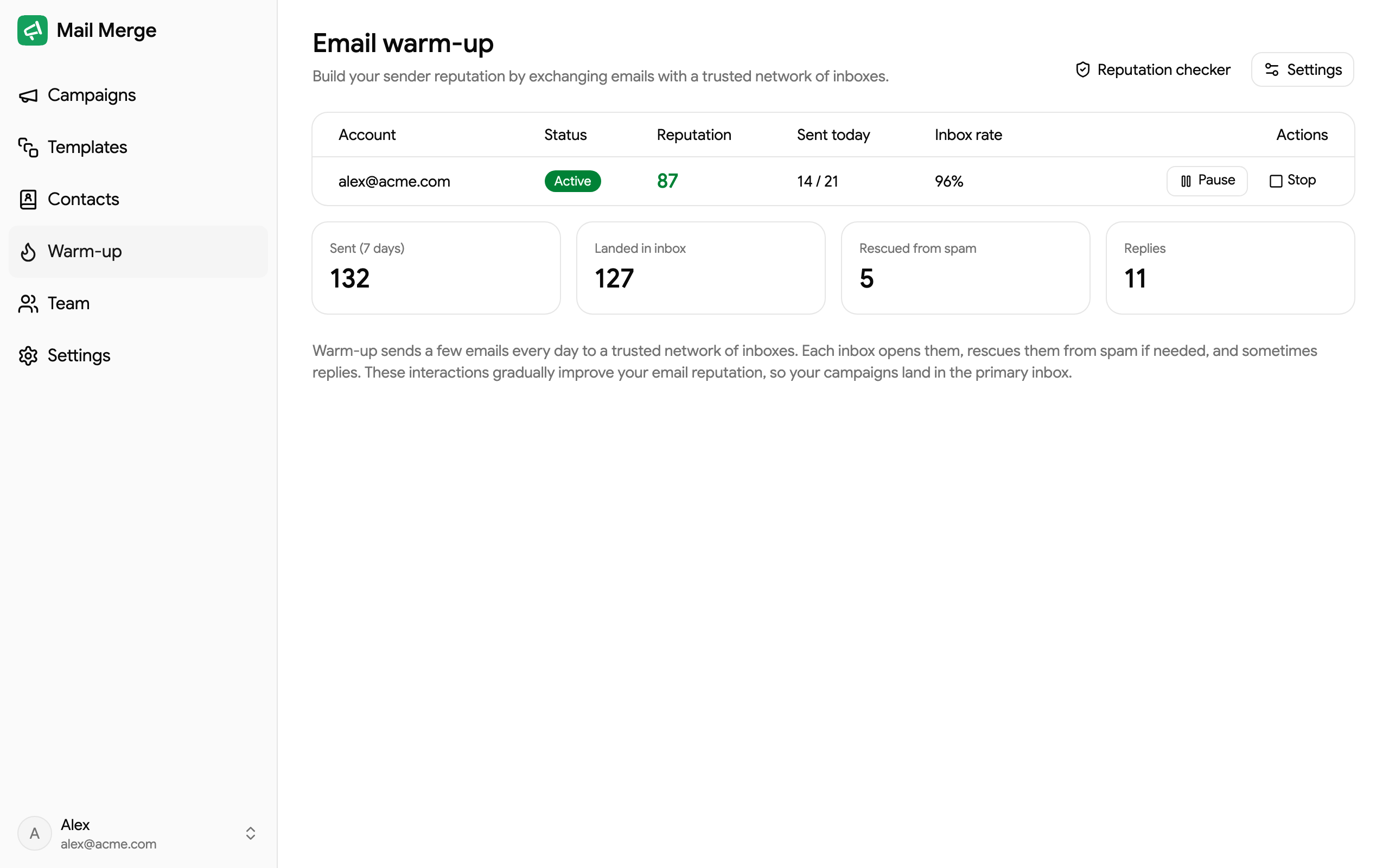
Section titled “Reading the dashboard”The account row shows the warm-up status, your current reputation score, how many warm-up emails were sent today against the daily target, and the inbox rate — the share of warm-up emails that landed in the inbox. Below it, four cards summarize the last 7 days: emails sent, how many landed in inbox, how many were rescued from spam, and replies received.
The daily volume ramps up gradually — starting small and increasing every day up to a maximum — so the sending pattern looks natural. You can tune the ramp under Settings (maximum emails per day and the daily increase); conservative values keep your account safest.
Use Pause to suspend the exchange without losing progress, and Stop to end warm-up and delete the stored app password (progress resets).
Email reputation checker
Section titled “Email reputation checker”The Reputation checker (button at the top of the Warm-up screen) is a free tool that scores any email address out of 100: DNS setup (MX, SPF, DKIM, DMARC, BIMI), blacklists, domain age, SMTP verification and more — with a pass/warn/fail detail for each check.
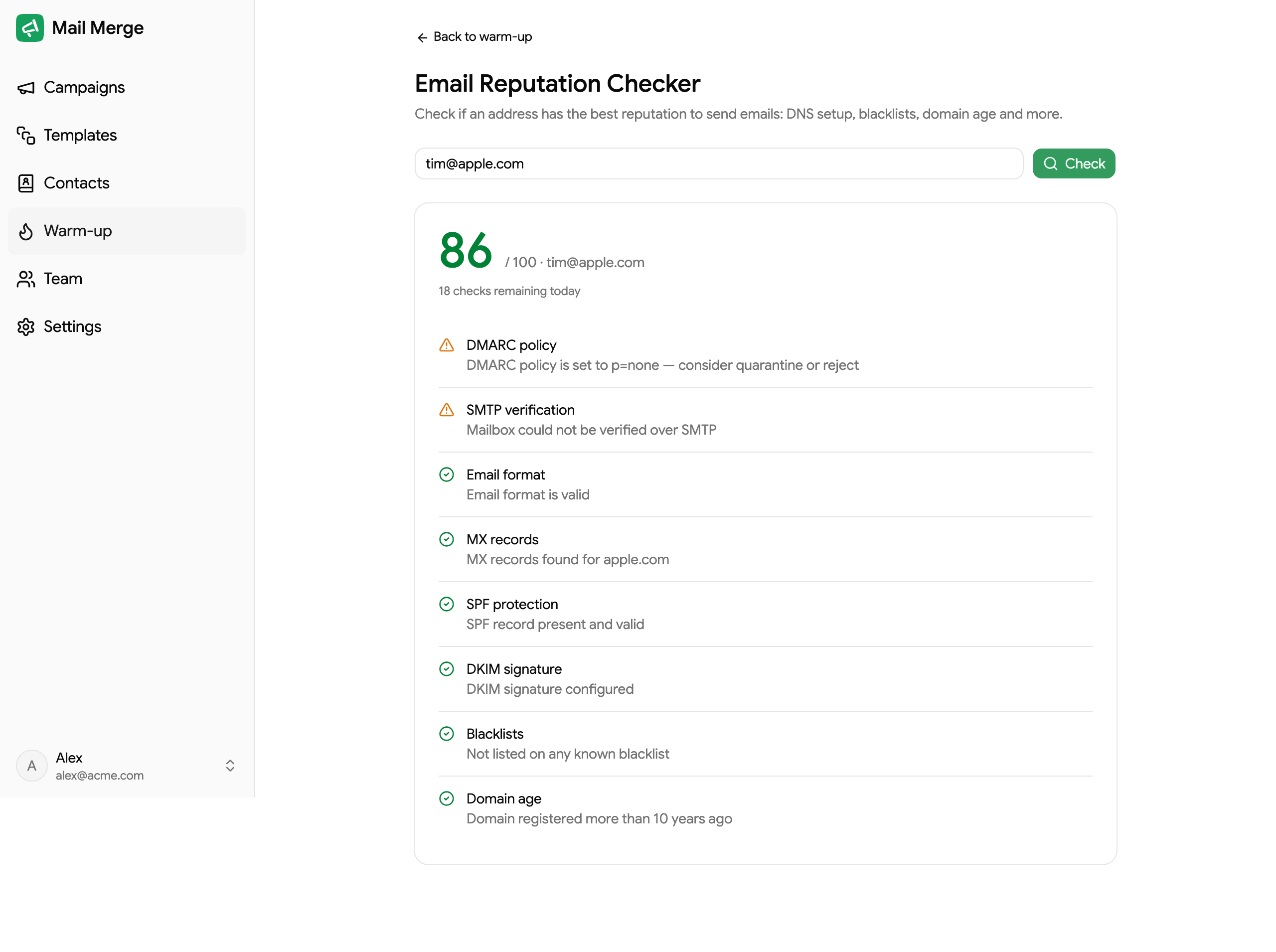
Check your own address before a big campaign — a missing SPF or DMARC record is one of the most common reasons emails land in spam.